
Special Retirement Provisions for Federal Firefighter Jobs - Age Requirement and Tools to Help When It's Time to Retire
When it comes to firefighter retirement benefits, understanding the various eligibility criteria and financial planning tools available for federal employees is vital for building a successful retirement after a career in federal service. Firefighters for federal agencies, similar to law enforcement officers and air-traffic controllers, have special provisions when it comes to their pension. This article will review the age and service requirements, other federal employee benefits for federal firefighters, including wildland firefighters, along with helpful tools for mapping out a solid financial plan with an annuity from the Federal Employee Retirement System (FERS) and a mandatory retirement age, meaning they must retire earlier than other feds, at age 57.
Retirement Contributions and Requirements for Firefighters in the Federal Government
Federal firefighting jobs are necessary when it comes to the safety of the American public and government operations. Agencies such as the U.S. Department of the Interior U.S. Forest Service, the Bureau of Land Management, and the National Park Service, employ federal firefighters to combat fires, manage wildland fires, and respond to emergencies. The
Firefighter Retirement Age and Requirements, including Years of Service
Firefighters in federal employment must meet specific retirement age and service milestones to be eligible to receive a pension. Generally, they can retire with full immediate benefits after 20 years of service upon reaching age 50, or at any age with at least 25 years of creditable service. The mandatory retirement age for these federal employees is 57 years old due to the physically demanding nature of the job.
Calculation of Federal Pension for Special Provisions Employees
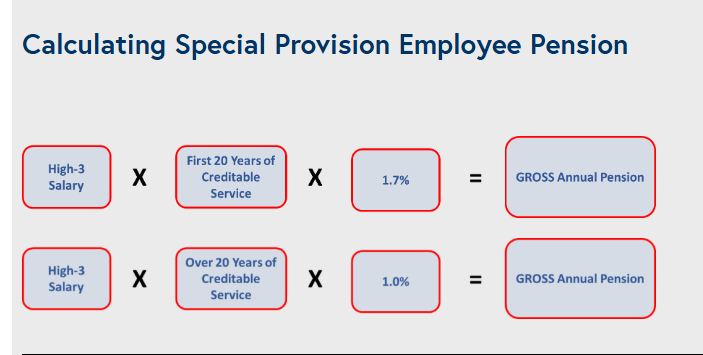
Federal Firefighters and others who retire under special provisions contribute an additional 0.5% of their salary to their pension fund when compared to normal federal occupations. That means the contribution rate is 1.3% if hired before 2013, 3.6% if hired in 2013 (FERS-RAE) and 4.9% if hired later (FERS-FRAE). The higher contribution rate leads to a higher multiplier when calculating the pension amount. FERS offers a pension based on years of service and high-3 average salary calculations, which take into account the highest three consecutive years of pay. A fireman employed with the government can receive a monthly annuity upon retirement, which is calculated based on their years of service and contributions to the retirement system. The calculation for a federal pension under special provisions is:
- First 20 years of service x 1.7% = A
- Year of Service after initial 20 x 1.0% = B
- A + B = Pension Amount
Eligibility for Different Types of Retirement under FERS
To be eligible for retirement, firefighters must meet the age and service requirements under FERS. Here are various options available:
| Type of Retirement | Years of Service | Age Requirement |
|---|---|---|
| Disability | 18 months | N/A |
| Deferred | 5+ | Before MRA |
| Postponed (MRA+10) | N/A | N/A |
| Regular FERS | 25 | Any Age |
| 20 | 50 |
Because federal firefighters aren't subject to age reduction penalties due to mandatory retirement, there is no reason to postpone their pension. At age 50 with 20 years of service, or at any age with 25 years, they are eligible for an unreduced immediate pension and the FERS special retirement supplement (SRS). With at least 5 years, though, they can defer their retirementor, if they qualify, can claim a disability retirement with 18 months of service. Whether aiming for early retirement or reaching the mandatory retirement age, firefighters can benefit from careful planning and knowledge of their retirement options.
Financial Planning Tools and Calculators to Assist Law Enforcement Officers and Firefighters with Retirement
Tools such as the FERS calculator, TSP calculator, and sick leave conversion tool can aid in your calculations when mapping out your FERS retirement. Additionally, FERS webinars hosted by experts in the field can provide valuable insights into maximizing your retirement benefits, and provide a detailed personalized benefits report.
Calculation Tools, Retirement Income Estimates, and Sick Leave Conversion Table
There are "three legs" to consider when retiring under FERS: the pension, the Thrift Savings Plan (TSP), and Social Security. And at PlanWell, we have tools to help with planning for all three income sources:
- The Federal Retirement FERS Benefit Calculator - a valuable tool for retirement planning, especially for firefighters considering their mandated retirement age. It allows users to input variables such as current salary, years of service, and expected retirement age to estimate their pension benefits.
- The FERS Supplement Calculator - The FERS special retirement supplement serves as a bridge until the individual is eligible to receive Social Security benefits. This tool allows individuals to estimate their retirement income and determine if they meet the eligibility requirements for a special retirement.
- The Thrift Savings Plan Calculator - individuals can estimate their retirement income from their investments in the TSP. Understanding how contributions and withdrawals work can help calculate benefits and determine the best time to retire.
Federal Retirement Workshops and Personalized Help with Civilian and Military Retirement Planning
A federal employee retirement benefits webinar is an invaluable resource for those approaching retirement, particularly for firefighters with special provisions. These webinars provide detailed information on retirement plans, benefits eligibility, and the retirement process. These sessions provide tips on maximizing retirement benefits, including information on health insurance, life insurance, and other post-retirement options. Participants can ask questions and receive fed-expert advice, helping them make informed decisions about their future. If you still have questions after the three hour session, you can book a no obligation meeting with a federal retirement expert that includes a detailed personalized report regarding all of your federal retirement benefits and what decisions need to be made before filing your application with the Office of Personnel Management (OPM).
Figure out your retirement strategy - Register for the Online FERS Workshop Here